 Strut Two
Setting up a planning meeting with a core organising group
This Strut is about setting up your first meeting to introduce the Catwalk4Power project and includes suggestions on how to facilitate groups and workshops.
To prepare to deliver the workshops programme, we found it useful to set up an initial planning meeting to introduce the Catwalk4Power project and to plan how to run the workshops.
For the initial meeting we suggest inviting:
Women with HIV
We have usually worked with established groups and asked group coordinators to invite women, but you could also use social media and word-of-mouth.
Artists
Artist/activist allies who may be interested in supporting the activities and performance with their skills and talent. To know more about allies see Strut 3.
HIV sector peers
Members of staff from an HIV charity or HIV clinic, or any other supportive organisation, who can collaborate with women with HIV and maybe provide a space to hold workshops.
Communicating essential information
Be clear about the meeting time, place, access, and confidentiality. Confirm whether there will be refreshments, travel expenses, and a creche. If you work with a local HIV group, they may be able to help with these.
Below are some guidelines for running a group meeting. These points can also be adapted for the workshops.
Opening information
Introduce yourself and your connection to Catwalk4Power. Explain that the project is peer-led by women with HIV for women with HIV, and aims to empower women with HIV. Explain that no experience is necessary, and everyone can join and contribute at any level they feel comfortable with.
Encourage participants to sit in a circle, either on comfortable cushions/chairs, with you (the session host) at the same level as them. Let participants know the location and accessibility of bathrooms (based on disabled access or gender neutral designation, etc.). Confirm fire exits and general house-keeping information, as well as mentioning time-keeping around refreshment breaks.
Check if participants have any questions before discussion begins. Ensure there is a place to note any issues that arise (flip chart, place to stick post-it notes, etc.). Make it known, that these points will need to be discussed in another session (you may refer to this place as the 'parking lot' for issues raised).
Introductory exercise
It is good to get to know each other and do some introductory exercises.
Examples include:
"Name game""
Decide on a quality name. For example, choose a quality with the same initial as your name: "I’m called Daring Daisy, Strong Sarah...". Encourage positive names.
"This week I am proud of"
Participants introduce themselves and say one thing they feel proud about having achieved in the present week (if there is nothing else they can think of, praise them for coming to the session). There should be mutual respect, across the group, for each woman’s achievement.
At the beginning of each workshop it is good to clarify the day’s agenda and the aim of the meeting. Check with participants if there is anything they would like to ask. Explain that you will be seeking feedback and evaluation from participants, as the session goes along, and also at the end. This is to make sure that, as far as possible, the workshop session meets needs and expectations. (Strut 1 explains mutual respect and confidentiality issues in detail.)
Creating a Safe Space
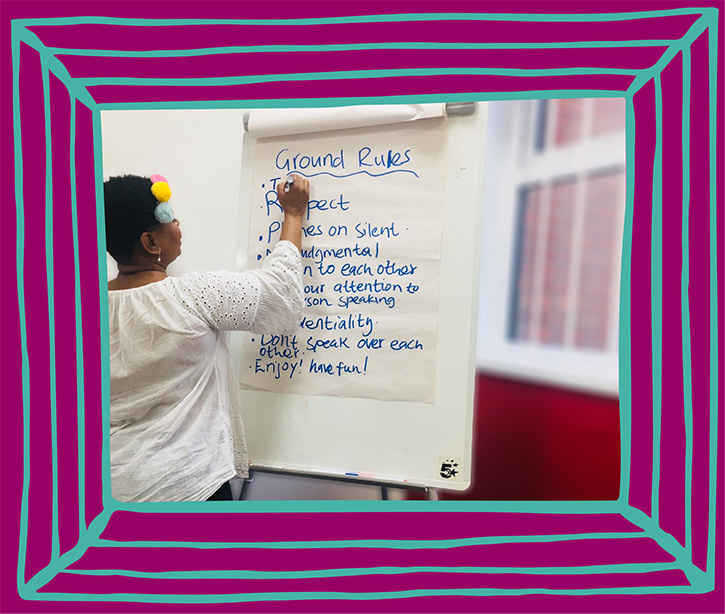
Work together to agree or review a group agreement. Emphasise the importance of:
- confidentiality
- mutual respect
- listening to others
- not interrupting
- respecting and celebrating diversity
- mutual support for difficult issues
- turning off mobile phones.
Agreeing actions and a timeline
At the end of the meeting, agree on any follow-up actions and dates for when these need to be addressed or completed.
If possible, it would great to agree dates for the five key workshops to prepare the Catwalk4Power performance.
Closing the Group
Thanks
Thank participants very much for sharing and contributing. Remind them that this is their group/space/time and encourage them to invite other women with HIV along, if it is felt by the group that this is appropriate.
Closing exercises
To close the group, we found it useful to have everyone say something about the session and what they found useful. You can see examples of closing exercises in the resource page.
Examples include:
Ask each participant to mention: "One thing I take away today…."
"Today I have..."
Encourage women to say (they can choose one and you can put those options on a flip chart):
- Something I have learnt is...
- Something I have appreciated is...
- Something that surprised me is...
- Something I am going to put into practice in my everyday life is...
You might think of other closing exercises but it is good to always have a round of comments at the end, during which we can check in with each other as well as provide feedback about the group/workshop.
Written feedback forms
We found it useful to also have written feedback forms.
Feedback can help us understand what went well and whether there were any difficulties for participants. Written feedback forms can be anonymous, and some people find it easier to give feedback this way.
Feedback forms are also important to report to existing funders and if you are seeking funds. These forms can show how effective the workshops are.
Ensure you leave at least 10-15 minutes for the evaluation and explain to participants why we are seeking their feedback.

Be open to the various skills and levels in the room. Encourage people to share how they would like to contribute and what skills they bring.

Take time to prepare and, if it helps, make some notes of what you would like to say. Take deep breaths and drink lots of water!

The 4M Training Manual has many great tips on group facilitation and opening and closing exercises.